|
Getting your Trinity Audio player ready…
|
On a Sunday night in January 2022, Cuc “Patty” Dao awoke with bizarre symptoms. Her vision was blurry and her equilibrium off. Dao, who was 53 at the time and living in Ukiah in rural Northern California, had always prided herself on being healthy, so this was a confusing moment. “I felt like my head was stuck to the ground,” she said. When the vomiting started, Dao assumed she had a virus or a bad reaction to a recent COVID-19 immunization.
“I’ve never been diagnosed with anything. I wasn’t on any medication. I worked hard, I paid taxes, I did everything,” said Dao. She didn’t visit the doctor all that much. Employed as a school crossing guard and a kindergarten assistant, she didn’t have much extra time or money for doctors. She planned to wait for her body to right itself.
That didn’t happen. Three days later, she conceded that the time had come to see a doctor. She asked her partner Scott Tucker to call an ambulance. By the time she arrived at the Adventist Health Ukiah Valley hospital emergency department, Dao had suffered a fifth stroke.
She was immediately airlifted 150 miles from Ukiah to Sacramento, where she received lifesaving medical care. At one point she dreamed that a guardian angel came to her and said, “Everything will be fine.”
Nobody said it would be easy, though.
Home to Ukiah — With ECM Support
Dao spent a month in the hospital. As she headed home to Ukiah with Tucker, she faced relearning how to walk, talk, and do the simplest tasks. That’s when a flesh-and-blood guardian angel appeared in the form of Tony Marsh, lead care manager for Adventist Health’s Community Connect Enhanced Care Management (ECM) program. A statewide Medi-Cal benefit for people in need of complex care, ECM is part of CalAIM, the long-term state initiative to put people at the center of care and focus on social determinants of health.
Marsh seemed to know everything about Dao’s situation, she said. Behind the scenes, Adventist’s team of licensed clinical social workers had identified Dao as eligible for ECM and knew she would need extra support. Unlike many hospitals, Adventist had a formal system to connect people to ECM.
Marsh’s team is housed in offices adjacent to the emergency department. The hospital’s admissions software automatically flags emergency patients likely to qualify for ECM services. This process enables lead care managers not only to support people in the community but also to show up at bedsides to support inpatients during a health crisis.
Dao was already a Medi-Cal enrollee. Now her needs had become so complex that she was eligible for ECM and was asked if she wanted to enroll. Marsh, a longtime Ukiah resident who has worked in homeless shelters, had always volunteered to assist populations facing the most difficult social and health challenges. Earlier in his life, he had endured a period of homelessness, an experience that makes it easier to relate to people in crisis. And Marsh had another significant connection to Dao — the kind of connection that is not uncommon in rural areas. “Her longtime partner was my English teacher in high school,” he said, “so we bonded fairly quickly.”
Marsh and the Adventist team promptly began helping Dao navigate her complex needs. They scheduled her physical therapy and medical appointments, and they made sure she had access to her prescriptions. Marsh helped her apply for food assistance and Medi-Cal In-Home Supportive Services for help with household chores. With such support, she progressed amazingly well, Dao said. She was talking, walking, and performing self-care tasks far more rapidly than doctors predicted.
Heading South
And then disaster struck again.
Tucker, her partner of more than seven years, died suddenly after a fatal cardiac event. When Dao found him, her first call was to Marsh, who immediately came to assist.
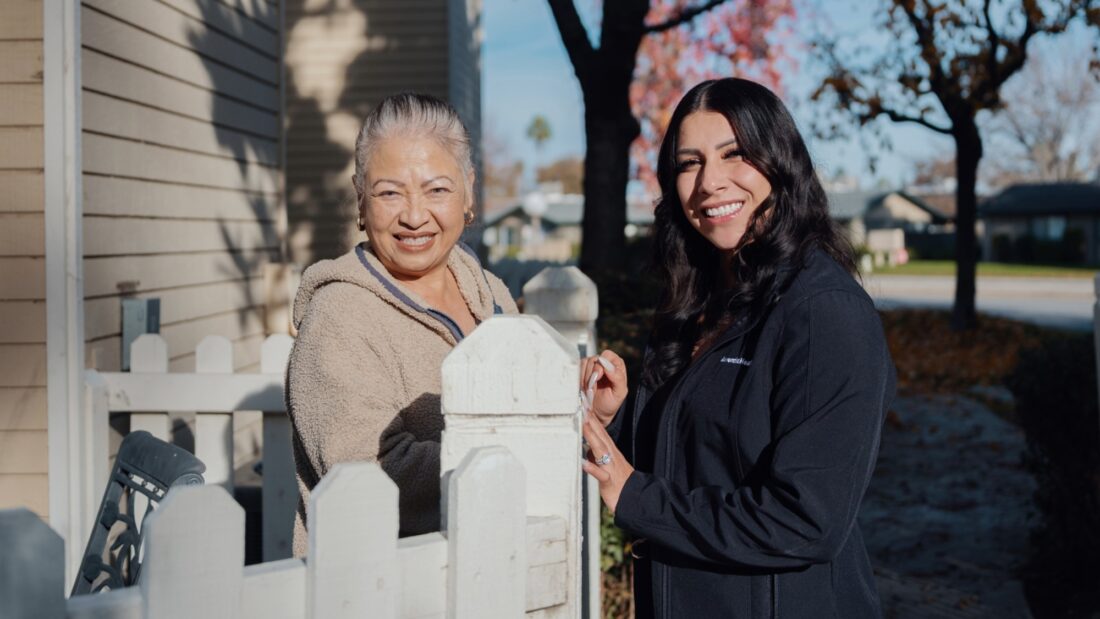
Dao was grief-stricken. Without Tucker, she ended up unhoused for a period, staying with various family and friends until she decided to relocate to Bakersfield to move in with her elderly, ailing mother. That meant Marsh had to deliver Dao to yet another ECM angel 400 miles south — Yeraldin “Yaya” Hernandez, a lead care manager for Adventist Health Bakersfield, a 254-bed hospital.
Moving, switching Medi-Cal plans, finding numerous care providers, and just getting a new pharmacy to fill prescriptions can be daunting challenges for anyone. The stress is multiplied if you’re grieving, recovering from a catastrophic health event, and living without transportation.
The message Hernandez gives all of her new ECM clients: “I’m here for you. I want to help you. Trust me. Rely on me.” Sometimes that’s a shockingly difficult sell. Many in the ECM population doubt anyone truly intends to help them.
“Get one thing done for them, even just one thing, and they’ll start trusting you,” said Hernandez.
Trusting CalAIM
Dao got a lot more than one thing done. Hernandez helped her establish new relationships with doctors and informed her about benefits for which she was eligible, like rides to medical visits and medically tailored meals prescribed by doctors. Hernandez walked Dao through calling an Uber for a doctor’s visit, and even went with her to the first visit. This is in keeping with the strategy. “The goal is to get people independent, so we teach them how to do things,” she said.
Adventist’s lead care managers undergo an intensive five-week training program before taking on their first case. Lived experience helps them greatly. Hernandez grew up in a family with low income, and from the time she was 6 years old, she served as the family interpreter. She also battled a chronic illness that started when she was 13.
“My background helps. To do this job, you must be a patient person with a lot of empathy,” she said.
Lead care managers are more than frontline workers doing heavy lifting with patients. They also do a tremendous amount behind the scenes to ensure the ECM program remains functional and financially viable, such as negotiating contracts with providers and community-based organizations, and meeting data integration requirements that enable billing systems.
The results fulfill the “Triple Aim” goal of three dimensions of performance, according to Yesenia Mock, Adventist Health’s system administrative director for value-based care. “This program improves population health, enhances the patient experience, and reduces health care costs,” Mock said.
Mission-Aligned Boost to the Bottom Line
This makes sense for Adventist, a hospital system that in California primarily serves rural areas and collects more than 80% of its revenue from Medicaid and Medicare. ECM has cut hospital readmissions and visits to emergency departments for non-emergency care. Hospitals across the state, including Rady Children’s Hospital in San Diego and Eastern Plumas Health Care in Portola, 45 miles due north of Lake Tahoe, show that ECM is a mission-aligned boost to the bottom line.
“As a lead care manager, we see the difference we make in people’s lives all the time,” said Marsh. “But it’s also nice to see data.”
In a single metric — reducing unnecessary visits to the emergency department — the Adventist ECM program has determined it helped the state save millions in health care expenditures.
“CalAIM aligns with the populations of focus that we have as a system,” Mock said. “It also aligns with the general consensus that navigation services are effective at reduction of ED utilization, and we’re seeing that reduction. We are actually transitioning patients from high-cost to low-cost settings of care. And that’s really what we want to see in value-based care.”
Dao is one of those who has not been back in the hospital. Doctors told her the strokes were due to unchecked high blood pressure, of which she was unaware. Ditto for being diagnosed as pre-diabetic. Now she visits her doctors on her own, including making the appointments and calling for an Uber ride on her own. She is caring for herself and walking more than a mile a day. “Lately, I’ve also been able to cook more, and I’m no longer pre-diabetic,” she said. She recently attended her son’s wedding, and she suspects that she’ll graduate from the ECM program fairly soon.
“I’ve had a lot of help and encouragement,” she said. “Without it, I don’t know where I would be.”
Authors & Contributors
Victoria Clayton
Journalist
Victoria Clayton is a writer in Southern California whose stories have appeared in The Guardian US, The Atlantic, the Washington Post, and many others. She’s a National Fellow at the USC Center for Health Journalism.

Adam Perez
Independent director and photographer
Adam Perez is an independent director and photographer born and raised in California’s rural Central Valley. The Emerson Collective, The Center for Cultural Power, The California Arts Council, and the Academy of Arts and Sciences have supported his work about farmworker communities. His work has been featured in The New York Times, the Los Angeles Times, The New Yorker, Time magazine, CNN, and NBC.