|
Getting your Trinity Audio player ready…
|
Artificial intelligence tools are increasingly used in California health care settings to ease barriers to patient access, support clinician workflows, and improve the quality of care. The benefits of AI technology are of great importance in safety-net settings, where clinicians and staff are stretched thin caring for Californians with significant health needs.
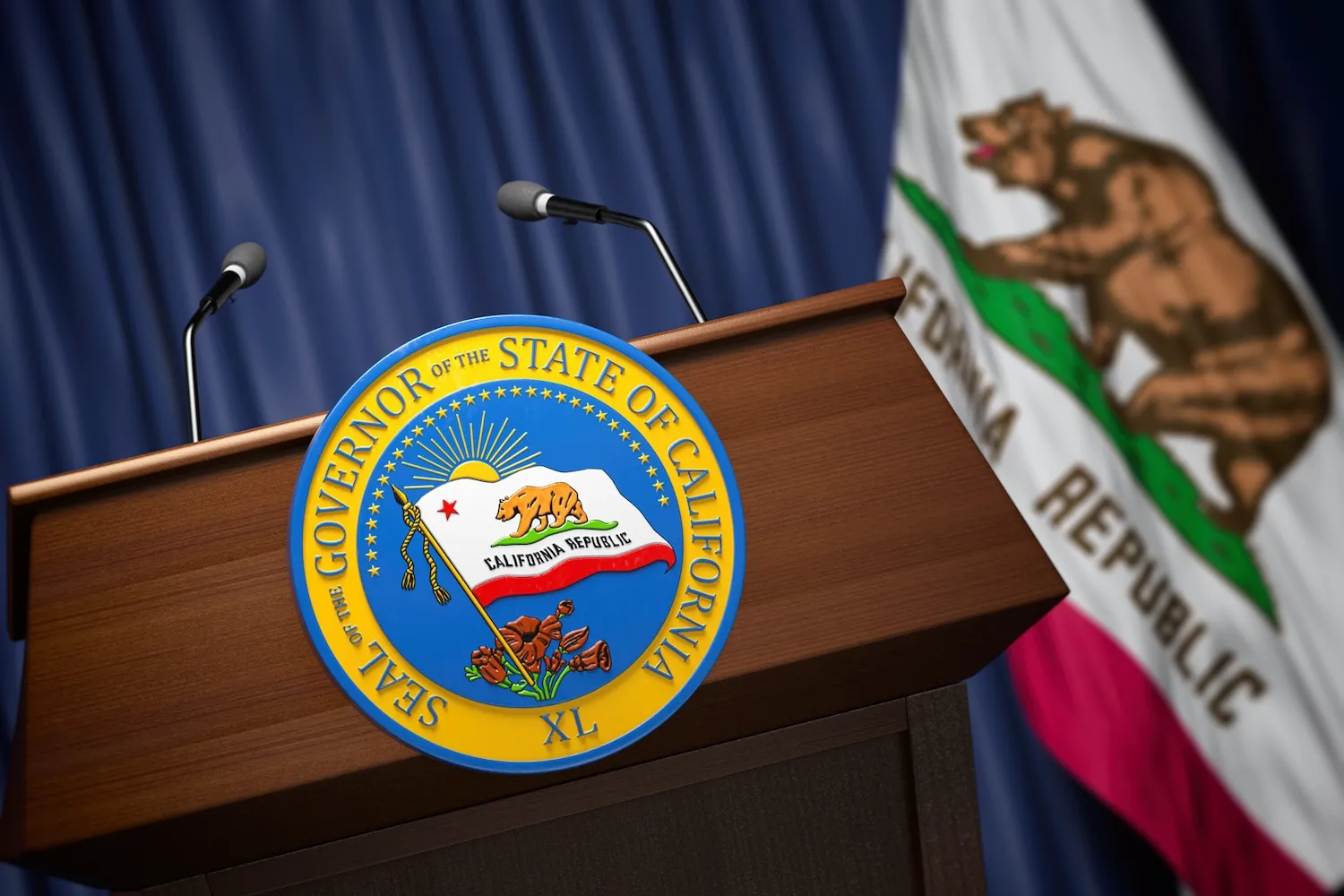
AI was a major priority for lawmakers during the 2025-2026 legislative session. They considered dozens of AI bills, many of which focused on health care. Gov. Gavin Newsom faced a Sept. 30 deadline to sign or veto bills that passed both houses of the state legislature. With his choices, Newsom has made human review requirements, bias documentation, and consent standards a baseline for California AI health care law.
We reviewed five key measures that reached the governor’s desk in September. Four deal explicitly with health care. One affects health care workers. He signed three into law and vetoed two, and we summarized each. The lead author’s last name is shown after the bill number.
In addition, we looked at an executive order on AI that Newsom issued in mid-September.
Three Health Care AI Bills Approved by the Governor
AB 1979 (Bonta)
Effective Jan. 1, 2027, this law defines clinical decision support systems as “an artificial intelligence system that produces a prediction, classification, recommendation, evaluation, or analysis that aids clinical decisionmaking related to timing of care, diagnosis, or treatment.” The definition covers tools that help clinicians make decisions about a patient’s diagnosis or treatment. A growing number of AI tools support clinical decision-making.
The law requires health facilities, clinics, and physician offices to take reasonable steps to ensure a licensed provider will exercise independent professional judgment whenever AI output informs patient care. AI cannot independently perform any clinical function the law reserves for licensed professionals. It also cannot be used to direct unlicensed staff in performing a clinical function. Trainees working toward licensure are exempt, as is AI used for scheduling and routine communication such as record updates and appointment reminders. Professional licensing boards will enforce the law.
Businesses offering health care chatbots will be treated as health care providers under the Confidentiality of Medical Information Act, with the same confidentiality duties and penalties.
SB 503 (Weber Pierson)
Also effective Jan. 1, 2027, this law sets bias-mitigation rules for clinical decision support systems.
The companies that develop these tools and the health facilities that deploy them must make reasonable efforts to identify systems that could produce biased results that cause worse access, care, or outcomes for people based on a protected characteristic such as race, sex, or age.
Developers will be required to take steps to reduce that risk. They must provide documentation to deployers that explains what data trained the AI tool, how it was tested, what it is intended to do, what could go wrong, and how to monitor it. Deployers must continue monitoring the tool’s effects and act on problems they find.
SB 947 (McNerney)
Starting July 1, 2027, employers using automated decision systems face new rules. The law covers software that scores, classifies, or recommends in ways that assist or replace human judgment about employees. We include it because health care is one of California’s largest employers and because it is the first substantive automation bill Newsom has signed.
Employers cannot use these automated systems to break labor or civil rights laws, guess an employee’s protected status, or punish someone for exercising their rights. Software alone cannot justify firing or disciplining a worker. A human must check the decision against other evidence, such as personnel files, supervisor reviews, or work product. Otherwise the software’s output cannot be used.
Two Health Care AI Bills Vetoed by the Governor
AB 2575 (Ortega)
This bill would have barred employers from punishing clinicians who override AI recommendations, and blocked AI vendors from blaming clinicians when a system caused harm. Workers could have filed retaliation complaints with the state labor commissioner.
In Newsom’s veto message, he cited the impracticality of the “solely based on” evidentiary standard and the labor commissioner’s lack of medical expertise to judge clinical standards of care.
SB 903 (Padilla)
The bill would have restricted AI use in psychotherapy to administrative and supplementary support. Patients would have had to give informed consent before AI recorded a session, transcribed it, or screened them for care. A checkbox buried in terms of use would not have counted. The bill also would have barred companies from marketing chatbot-delivered services as therapy or calling a chatbot a “therapist.” A licensed professional would have had to review and approve AI-generated therapeutic decisions, diagnoses, assessments, and treatment plans, as well as any AI effort to detect emotions or mental states or perform triage. Direct psychotherapeutic communication with a patient would have been off limits unless the tool was cleared by the Food and Drug Administration.
Newsom said in his veto message that the definitions and scope were so broad they would harm legitimate clinical tools never meant to replace psychotherapy.
The Governor’s Executive Order
Newsom issued an executive order Sept. 18 addressing AI safety concerns associated with AI technology. It responds to researchers’ warnings that the technology poses an existential risk to humanity and to prominent autonomous hacking incidents.
The order accelerates the implementation of two other bills passed this year, SB 813 and AB 1405, which regulate how outside groups evaluate AI programs for safety. It also convenes experts to give the state recommendations within two months on strengthening existing AI safety and security laws. These actions are aimed at the most advanced general-purpose AI systems currently being developed, often called frontier models. Policymakers, researchers, and the public have raised concerns that these increasingly capable systems could enable large-scale harm, including sophisticated cyberattacks and other security threats.
The order addresses broad societal risks from frontier models. It does not reach the narrowly defined clinical decision support tools used in health care settings.