|
Getting your Trinity Audio player ready…
|
One of Rachel Mitchell’s formative experiences as a UC Davis medical student and a resident physician occurred when she was working at a community clinic in California’s rural Amador County. A farmworker with limited English proficiency came in for a routine checkup. The attending doctor noticed the patient seemed unwell and spoke with him in Spanish. That led to a diagnosis of leukemia.
“Nobody had ever taken the time to really understand what was going on with this person,” Mitchell said. The attention “led to an important diagnosis that had previously been missed.”
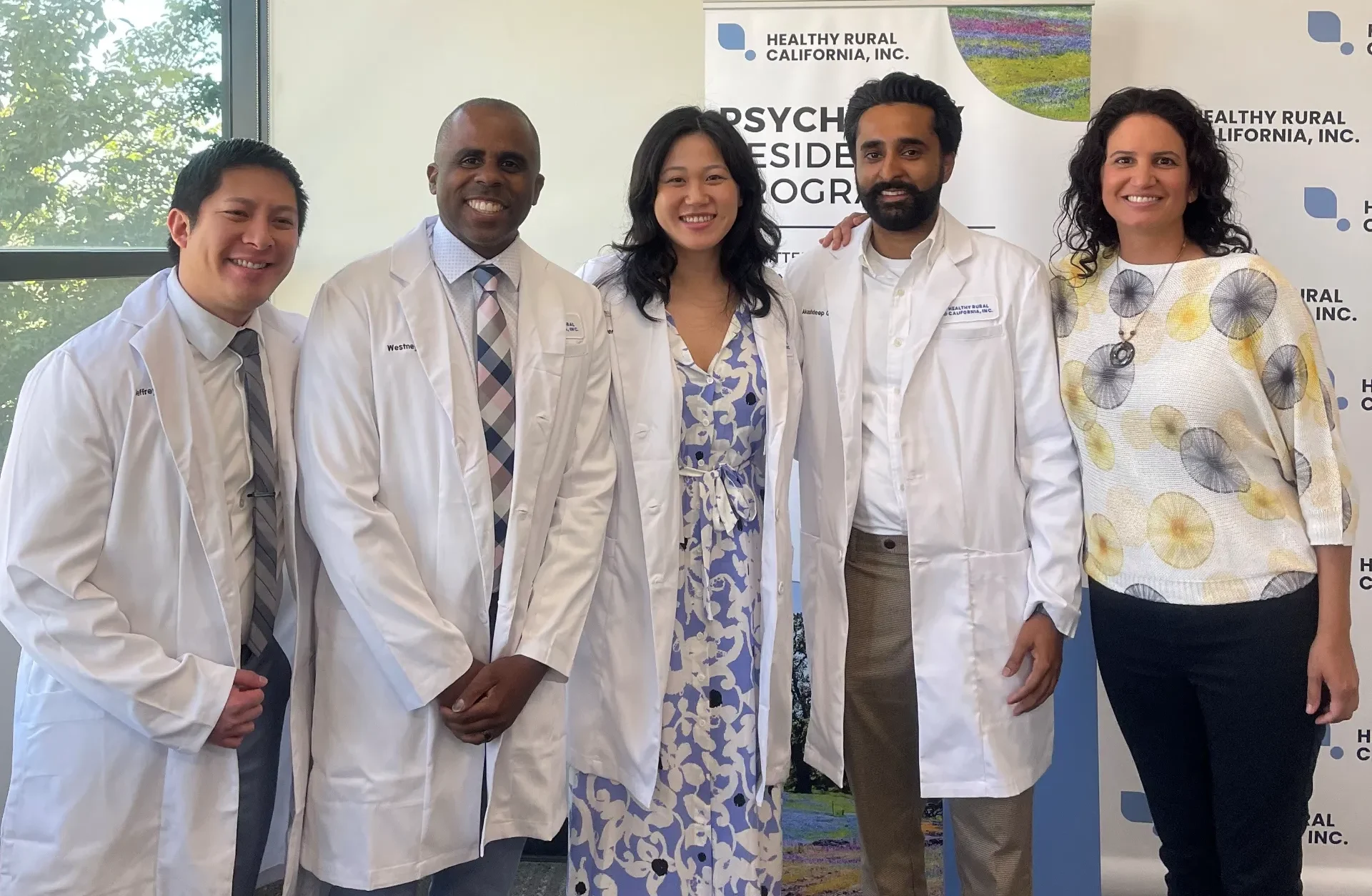
Mitchell is now an attending physician providing primary and behavioral health care to people experiencing homelessness. She is also inaugural program director of Healthy Rural California’s psychiatry residency. The program trains doctors at “teaching health centers,” or THCs. THCs, which can be housed in community clinics, federally qualified health centers, and other outpatient settings, receive federal funding. Most are in communities where disparities in access and health outcomes are pronounced.
Where doctors train determines where and how they will practice, so bringing residents to California’s underserved rural north could fill service gaps for decades to come. “We’re in this for the long game,” Mitchell said.
We ask, ‘What does your spouse do? Let’s find them a job, find a good school for your kids.’ Then you’re here, you’re entrenched, and you’re going to stay.
Rachel Mitchell, MD, MPH, Healthy Rural California
Most medical students and residents don’t get this sort of training opportunity. Medical school graduates typically complete their education in urban teaching and research hospitals. Only 2% train in outpatient community settings, where most care is delivered.
Post-graduate residencies and fellowships (known as graduate medical education, or GME) have traditionally been funded by Medicare dollars, which cannot be directed to health centers and other community clinics. That’s why residencies and fellowships skew sharply toward hospital systems in metropolitan areas.
With new funding models available, educators and advocates are developing creative ways to launch and sustain THC training programs that can equitably rebalance the geographic distribution of physicians and specialists.
Embedding Physicians in Places That Need Them
California has only seven teaching health centers, with three more expected this year. The beneficial impact that would result from many more THCs in the nation’s most populous state would be significant. Programs could address workforce shortages in primary care and psychiatry while recruiting and training physicians with backgrounds that resemble those of their patients.
Residents drawn to these programs tend to be younger, more diverse racially and ethnically, and more likely to speak multiple languages than hospital-based trainees. THCs that bring trainees and teaching physicians to the area immediately improve capacity and wait-times.
Many community-based clinics want to become THCs but have been ineligible for funding. But new non-Medicare federal funding streams have put increased community-based residencies within reach. Since 2010, the federal Health Resources and Services Administration has funded teaching health centers in underserved communities, yielding more than 3,000 doctors and dentists.
Each year, approximately 50,000 US medical school graduates enter THC residency training, with about 1,250 of them at 88 programs.
Natasha Bray, DO, helps manage one of the nation’s largest THC networks in Oklahoma. Through partnerships between Oklahoma State University, tribal nations, and community hospitals, she and colleagues have embedded internal medicine, family medicine, and pediatrics residents into THCs, including one in a town with a population of less than 1,000. Residency tracks in obstetrics and general surgery are in the works. “Instead of making patients adapt to our system,” Bray said, “we train physicians to meet community need.”
The results have been striking, increasing capacity measurably. In Cherokee Nation, the Indian tribe with more than 450,000 members in northeastern Oklahoma, appointment wait times for new primary care patients fell from eight months to six weeks. In July, the tribe opened a community hospital in the tribal capital of Tahlequah with a Level 2 neonatal intensive care unit (NICU) and a cardiac catheterization lab. Cherokee cancer patients no longer need to travel to Tulsa for treatment, and mothers with babies in the NICU can stay closer to home.
Many Models for Funding Programs
Expanding the model in California will require finding ways to fund them. Since community clinics run on thin margins, they may have difficulty arranging funding and achieving accreditation on their own, said Emily Hawes, PharmD, director of the federally funded Rural Residency Planning and Development and Teaching Health Center Technical Assistance Center.
Hawes’ organization has helped nearly 120 clinics and health systems develop residencies in rural and underserved areas, which include training slots at teaching health centers. Most follow one of three funding routes: federal grants for teaching health centers, agreements with universities or hospital systems that unlock Medicare dollars, or a mix of various state and independent funding sources. It’s critical for programs to seek funding opportunities from clinics, universities, hospitals, counties, and legislatures to form the right alliances. “Shared mission, clear governance, and strong agreements” make the programs work, Hawes said. “It needs to be a mutually beneficial partnership.”
The UC Davis psychiatry department chose the academic-community partnership path. More than two decades ago, the department contracted with Sacramento County Mental Health to “help grow their clinical, teaching, and research missions into the community,” said Lorin Scher, MD, the department’s vice chair for education. The self-funded program now includes residency rotations at four Sacramento-area health centers and the county jail psychiatry unit. All department medical residents are required to do a community rotation as well.
Those opportunities attract applicants who care deeply about health equity and community health, Scher said. They also build a pipeline for a field whose workforce has not kept pace with rising demand. UC Davis produces twice the national average of medical students going into psychiatry, he said.
The department’s success with community partnerships is grounded in its long-term perspective, because these programs can’t be built overnight, he said. “We’ve been working on this a long time,” Scher said.
The incremental approach has paid off. The program recently landed a $2.6 million CalMedForce grant. “It’s easier for us because we’re part of a larger organization with different funding mechanisms,” Scher said. “I worry about smaller community programs and sustainability. Political winds shift, funding changes, and wonderful programs get shuttered because of bad luck.”
Continual diversification of funding is a hallmark of successful programs. In Oklahoma, the training pipeline is fed by individual donors, foundations, funds from tobacco and pharmaceutical settlements, and government dollars.
In Florida, the statehouse in Tallahassee is a wellspring of funding. Community health centers worked with legislators on Live Healthy, a 2024 policy package that supports medical and dental training in underserved areas. The initiative has been so successful that other states want to replicate it, said Jonathan Chapman, president and CEO of the Florida Association of Community Health Centers.
But political partnerships can be precarious. “We’ll have to keep showing value and impact,” Chapman said.
A Virtuous Cycle
Lasting THC partnerships prioritize open dialogue and mutual respect, say their leaders. When he joined UC Davis as associate training director for its psychiatry residency, Benjamin Belai, MD, brought with him a longstanding community partnership. Roots Community Health, an Oakland-based clinic organization, serves Alameda and Santa Clara counties with an emphasis on people released from jails and prisons.
Academic centers can go into these partnerships with a false idea that they have something to offer and that community partners should just accept it. But community partners offer their own expertise.
Benjamin Belai, MD, UC Davis
For years, Roots asked its academic partners to extend medical residents’ rotations to give them more time at the clinic. Their patients tend to distrust the system because of lived experience with trauma or mistreatment, so they care deeply about continuity of care.
“In psychiatry, if a provider leaves after two months, harm can be caused,” Belai said. “Patients might feel abandoned and might stop going to clinic.”
UC Davis listened, and the six-month rotation now spans a full year. That’s long enough for medical residents to know every primary care doctor and patient navigator in the building, take on their own patients, and become interested in staying on after graduation. “It made a huge difference,” he said.
“Academic centers can go into these partnerships with a false idea that they have something to offer and that community partners should just accept it,” Belai said. “But community partners offer their own expertise. They can provide us with knowledge and information about the communities that we are trying to help.”
Once a program has gotten off the ground, medical trainees in community clinics learn a kind of medicine that can’t be taught in a hospital, where a specialist who can take over a difficult case is only a page away. They build new skills and confidence that help patients.
That’s how Elizabeth Philippe, MD, chief of family medicine at Community Health of South Florida, describes her THC residency. With 13 community clinics in the Miami area, the organization serves patients burdened by poverty and uninsurance. Since 2014, the organization has graduated 71 psychiatry and family medicine residents, all of whom learn to care for patients in a system stretched to capacity.
The benefits show up in places where graduates put down roots. Nationally, 86% of THC residency graduates work in medically underserved communities, including rural areas.
At UC Davis, 30% of psychiatry residents comes from the university’s medical school, drawn partly by the community partnerships. After graduation, 90% stay in California, while 73% stay in the Sacramento region.
Staying Power
Each year on the first day of orientation for Healthy Rural California medical residents, the Butte County community delivers gift baskets to the young doctors. Flyers with the residents’ photos go up around town. This is part welcome, part strategy. Mitchell recruits residents with rural backgrounds and ties to Northern California, then connects their families to the community.
“We ask, ‘What does your spouse do? Let’s find them a job, find a good school for your kids’,” she said. “Then you’re here, you’re entrenched, and you’re going to stay.”
When patients know their providers and can easily access nearby care, they are more likely to trust the delivery system, she said.
UC Davis medical students have already matched into the psychiatry program, which operates five sites in Sutter and Yuba counties, including one in partnership with Feather River Tribal Health. That means the pipeline Scher has been building is starting to flow.
“It really warmed my heart to have these talented medical students from UC Davis match there successfully,” he said. “From a population health perspective, we don’t need them [in Sacramento] as much as we need more psychiatrists in rural settings like Chico and its surrounding counties.”
Healthy Rural California has not yet graduated residents, and Mitchell is monitoring what happens. She expects the physicians to stay, build lives in the region, and practice the kind of medicine she first saw in Amador County a decade ago.
“Five years down the line,” she said, “we’re going to have more health care providers and more mental health care in the community.”