Introduction
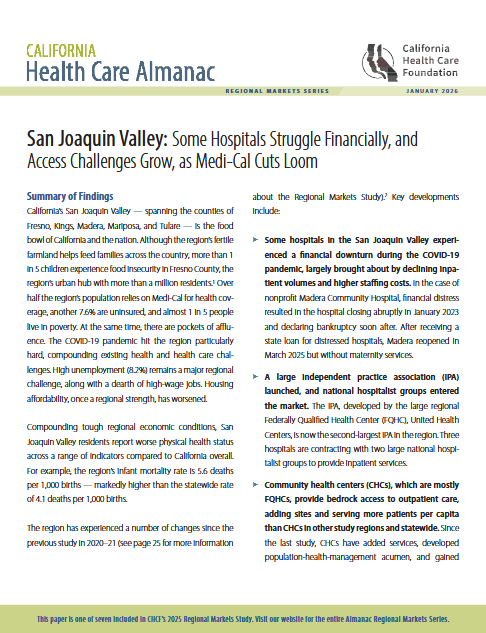
Between March and June 2025, researchers from Yegian Health Insights, LLC, conducted interviews with health care leaders in the San Joaquin Valley counties of Fresno, Kings, Madera, Mariposa, and Tulare in central California to study the market’s local health care system. San Joaquin Valley is one of seven markets included in the 2025 Regional Market Reports, which focus on gaining key insights into the organization, financing, and delivery of care in communities across California and over time.
A Region of Contrasts
California’s San Joaquin Valley feeds families across the nation, yet more than 1 in 5 children in Fresno County — the region’s urban hub with over a million residents — experiences food insecurity. This paradox defines a region where agricultural abundance coexists with significant health and economic challenges.
Over half of the region’s residents rely on Medi-Cal for health coverage. Another 7.6% are uninsured. Almost 1 in 5 people live in poverty. At the same time, there are pockets of affluence.
Economic Pressures Compound Health Challenges
The COVID-19 pandemic hit the San Joaquin Valley particularly hard, intensifying existing health and economic struggles. Unemployment remains at 8.2% — nearly twice the statewide rate. Housing affordability, once a regional strength, has worsened significantly.
Health Outcomes Lag Behind State Averages
San Joaquin Valley residents report worse physical health status across many indicators compared to California overall. For example, the region’s infant mortality rate of 5.6 deaths per 1,000 births is markedly higher than the statewide average of 4.1.
Five Key Developments Shaping the Regional Health Care Market
1. Hospital Financial Strain
Several hospitals experienced financial downturns during the pandemic due to declining inpatient volumes and rising staffing costs. Madera Community Hospital declared bankruptcy and closed in 2023, though it reopened in March 2025.
2. New Market Entrants
United Health Centers, a large regional Federally Qualified Health Center (FQHC), launched a for-profit independent practice association called United Physicians Network. National hospitalist groups also entered the market.
3. Community Health Centers Expanding Access
The region’s CHCs, which are mostly FQHCs, added sites and now serve more patients per capita than CHCs in other study regions and statewide.
4. Persistent Workforce Shortages
The region continues to struggle with chronic shortages across the spectrum of health care professionals.
5. Policy Uncertainty
State Medi-Cal transformation initiatives have brought new benefits and behavioral health infrastructure investments. At the same time widespread anxiety exists about potential federal Medicaid budget cuts — especially following recent state budget reductions.
Key Data on the San Joaquin Valley
Health Insurance Coverage
How do San Joaquin Valley residents get their health coverage?
Medi-Cal is by far the most common source of health coverage in the region, covering more than half of all residents. Only one-third have commercial insurance — compared to half of Californians statewide.
Sources: MA State/County Penetration (July 2019 and July 2023), US Centers for Medicare & Medicaid Services, “Selected Characteristics of Health Insurance Coverage in the United States, American Community Survey, 1-Year and 5 Year Estimates,” US Census Bureau, “By Medicare Dual Status, Certified Eligibles,” California Department of Health Care Services, Katherine Wilson, California Health Insurers, Enrollment Almanac — 2025 Edition, California Health Care Foundation, February 2025
Population and Economic Context
How does the San Joaquin Valley compare to California overall?
While the state’s population declined slightly over five years, the San Joaquin Valley grew by 2.9%. Economic and health data reveal significant challenges, although there are a few indicators that show the region faring better than the state overall.
Hospital Landscape
Which hospitals serve the San Joaquin Valley?
Three hospitals accounted for nearly 60% of the region’s discharges in 2023: Community Regional Medical Center, Kaweah Delta Medical Center, and St. Agnes Medical Center. Financial performance across hospitals varied widely, with net income margins ranging from -39% at Madera Community Hospital to 13% at Adventist Health Hanford. Madera Community Hospital closed in 2023 and declared bankruptcy but reopened in 2025. (Read the full report to learn more.)
Sources: 2023 Pivot Table – Hospital Annual Selected File, California Health and Human Services Agency
Community Health Centers
What are the main community health centers in San Joaquin Valley?
Community health centers — mostly FQHCs— are the backbone of outpatient care for the region’s safety net, providing 3.2 million visits in 2023. Half of these visits were at just two community health centers: Family HealthCare Network and United Health Centers. Medi-Cal accounts for 77% of net patient revenue at the region’s community health centers.
Health Care Workforce
How does the San Joaquin Valley compare to California?
There are fewer physicians, advance practices providers (nurse practitioners and physician assistants), nurses, and behavioral health providers per 100,000 people in the San Joaquin Valley than in California overall. The gap is widest for physicians and behavioral health providers.
Source: “2024 License Renewal Survey Data, Representing Active Licenses as of December 3, 2024,” custom data request, HCAI, received April 14, 2025.
San Joaquin Valley — Regional Market Report 2025
Authors & Contributors
Jill Yegian, PhD
Project Director and Regional Lead (Shasta/Lassen and Los Angeles)
Ted Calvert
Project Manager
Caroline Davis
Regional Lead for San Francisco Bay Area and San Diego/Imperial
Len Finocchio
Regional Lead for San Joaquin Valley and Sacramento
Marian Mulkey
Regional Lead for Inland Empire
Katy Wilson
Data Lead
Alwyn Cassil
Editorial Lead
Karen Shore
Events Lead
Jessica McLaughlin
Research Assistant