Introduction
The San Francisco Bay Area has long been one of California’s wealthiest and healthiest regions. As health care costs escalate, the large health systems continue to expand and compete for patients. In addition, the rising cost of living and housing shortage have contributed to growing inequality and a homelessness crisis. The region’s drug overdose rate has increased in recent years.
This report examines how county governments, hospitals, health plans, physicians, and safety-net providers in Alameda, Contra Costa, and San Francisco Counties are navigating the ever-evolving market.
These Bay Area counties make up one of seven markets included in the 2025 Regional Market Reports, which focus on gaining key insights into the organization, financing, and delivery of care in communities across California and over time.
Summary of San Francisco Bay Area Health Care Market
Escalating Costs and Growing Health Disparities
The Bay Area’s increasing cost of living and persistent housing shortage have widened income disparities and fueled a significant homelessness crisis — with direct consequences for health.
Meanwhile, already high health care costs continue to escalate, driven by rising labor and supply costs, higher-than-expected utilization, and intense competition among large dominant health systems for commercially insured patients.
A Highly Concentrated Hospital Market
The Bay Area hospital market is among the most concentrated in California. A handful of large regional health systems dominate, leaving only a small number of truly independent hospitals. The large regional systems continue to expand outpatient capacity, particularly in the East Bay, to compete for patients.
Physician Workforce Pressures and the Erosion of Independent Practice
While the Bay Area has more physicians and clinicians per capita than California overall, the region’s high cost of living makes recruiting and retaining providers difficult.
Independent practice continues to erode as younger clinicians increasingly choose employment over independent private practice. Physicians of all ages continue to join hospital-affiliated medical groups and larger physician organizations.
Six Key Developments in the San Francico Bay Area Health Care Market
1. High Labor and Supply Costs Strain Health Plans and Providers
Health plans and providers across the Bay Area are experiencing higher-than-expected utilization alongside rising labor and supply costs. As providers work to manage risk-based payments, population health management remains a central focus.
2. Large Health Systems Double Down on Expansion
Despite financial pressures, large regional health systems are accelerating expansion, with a focus on outpatient capacity in the East Bay. Sutter Health and UCSF Health are both building new hospitals to meet California’s 2030 seismic compliance deadline.
Kaiser Permanente, long the region’s dominant health plan and delivery system, faces intensifying competition.
3. Safety-Net Hospital Consolidation Accelerates
Facing increased financial pressure, three independent safety-net hospitals were acquired by larger systems. In 2024, UCSF Health acquired Dignity Health’s two San Francisco hospitals, while Alameda Health System, the public hospital system in Alameda County, acquired St. Rose Hospital in the East Bay.
4. Independent Physician Practice Continues to Decline
The shift away from independent practice is accelerating in the Bay Area. As more physicians join employed medical groups, and local medical groups are acquired by publicly-traded entities, questions remain about the impact on access to services and costs of care.
5. Medi-Cal Cuts Threaten Safety-Net Providers
Safety-net health plans and providers are watching looming Medi-Cal cuts with serious concern. California state budget deficits and proposed federal cuts under HR 1 — which would reduce federal Medicaid spending by an estimated $911 billion nationally over 10 years — threaten the financial viability of community health centers, public hospitals, and safety-net health plans serving the Bay Area’s most vulnerable residents.
6. Behavioral Health Funding Brings Promise and Implementation Challenges
New state and local behavioral health initiatives are bringing significant new funding to the Bay Area — a welcome development for a region grappling with a homelessness crisis and rising overdose deaths. However, services remain fragmented, and the sheer volume of new initiatives has created overwhelming implementation challenges for providers and health systems.
Key Data on the San Francisco Bay Area
Health Insurance Coverage
Where do San Francisco Bay Area residents get their health coverage?
A sign of the region’s relative affluence, a higher portion of Bay Area residents (65%) have commercial insurance than Californians overall (51%) and a lower portion (26%) rely on Medi-Cal compared to the state average (36%).
Population and Economic Context
How does the San Francisco Bay Area compare to California overall?
Bright spots in the region include a higher college education rate and lower unemployment compared to the rest of the state. Still, one in 10 Bay Area residents lives in poverty, and the region has a higher rate of drug overdose deaths compared to California overall. The three-county region’s population declined by 1.5% between 2019 and 2024 compared to 0.2% statewide.
Hospital Landscape
What are the largest hospital systems serving the San Francisco Bay Area?
The Bay Area hospital market is highly concentrated. Kaiser and Sutter Health are the dominant systems. Hospital net income margin (-2%) is much lower than the California average (4%), which is likely driven, in part, by higher operating costs in the region.
Community Health Centers
What are the largest community health center (CHC) systems in the Bay Area?
Known across California for a strong health care safety net, the three Bay Area counties operate a public hospital or health system as well as outpatient clinics. In addition, noncounty CHCs also serve safety-net patients across the region.
A total of 46 CHCs, including many designated as Federally Qualified Health Centers, operate 95 sites across the three counties. These CHCs and Federally Qualified Health Centers include a combination of county-run clinics, hospital-based clinics, and community-based clinics. Below are the largest CHC systems in the region.
Health Care Workforce
How does the San Francisco Bay Area compare to California?
The Bay Area has a robust local supply of health care professionals, likely due to the concentration of large health systems, academic medical centers, and several medical schools across the region. The region generally has more health care providers, of various kinds, per 100,000 residents compared to the state, with the exception of nurses.
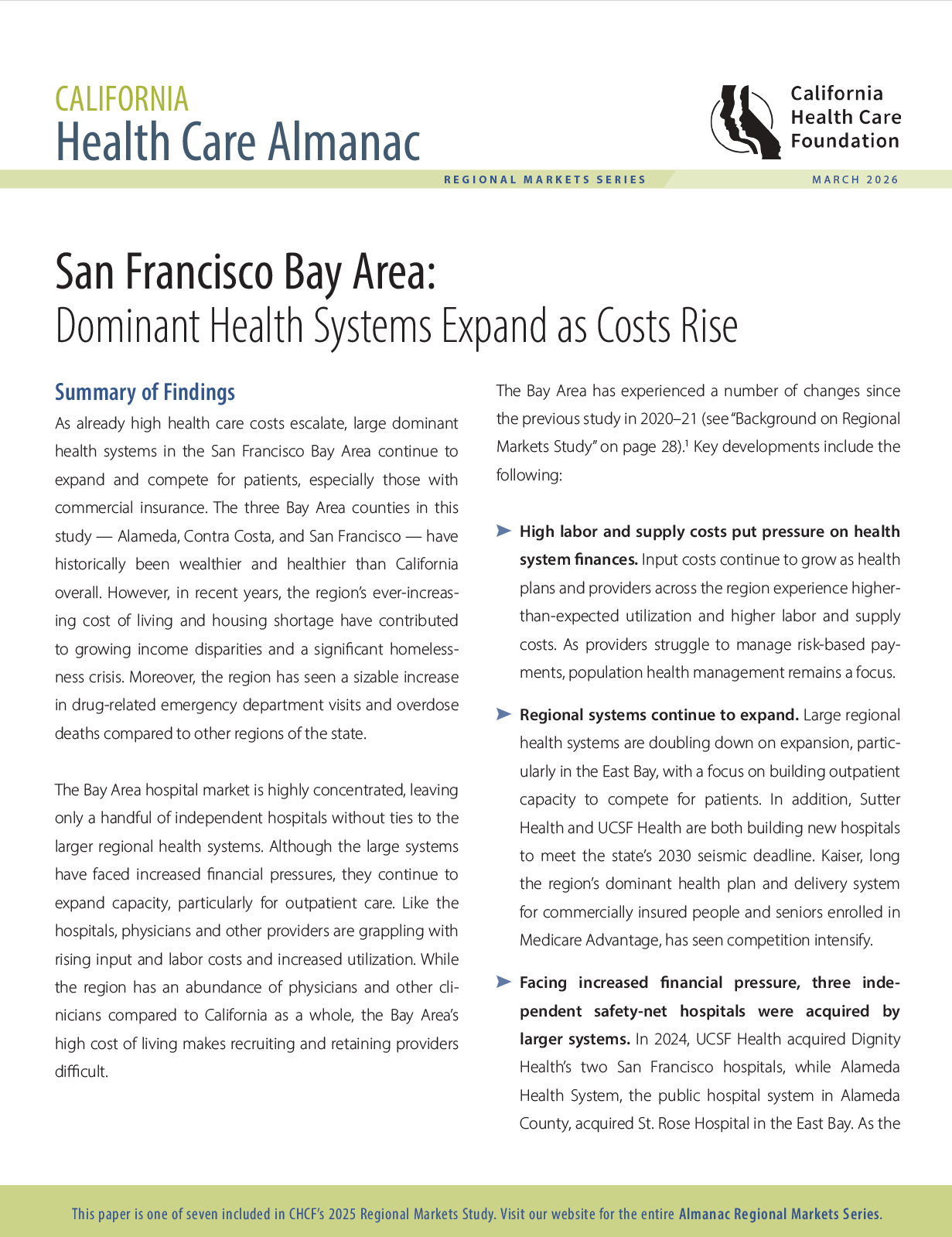
San Francisco Bay Area — Regional Market Report 2025
Authors & Contributors
Caroline Davis
Regional Lead for San Francisco Bay Area and San Diego/Imperial
Jill Yegian, PhD
Project Director and Regional Lead (Shasta/Lassen and Los Angeles)
Ted Calvert
Project Manager
Len Finocchio
Regional Lead for San Joaquin Valley and Sacramento
Marian Mulkey
Regional Lead for Inland Empire
Katy Wilson
Data Lead
Alwyn Cassil
Editorial Lead
Karen Shore
Events Lead
Jessica McLaughlin
Research Assistant