|
Getting your Trinity Audio player ready…
|
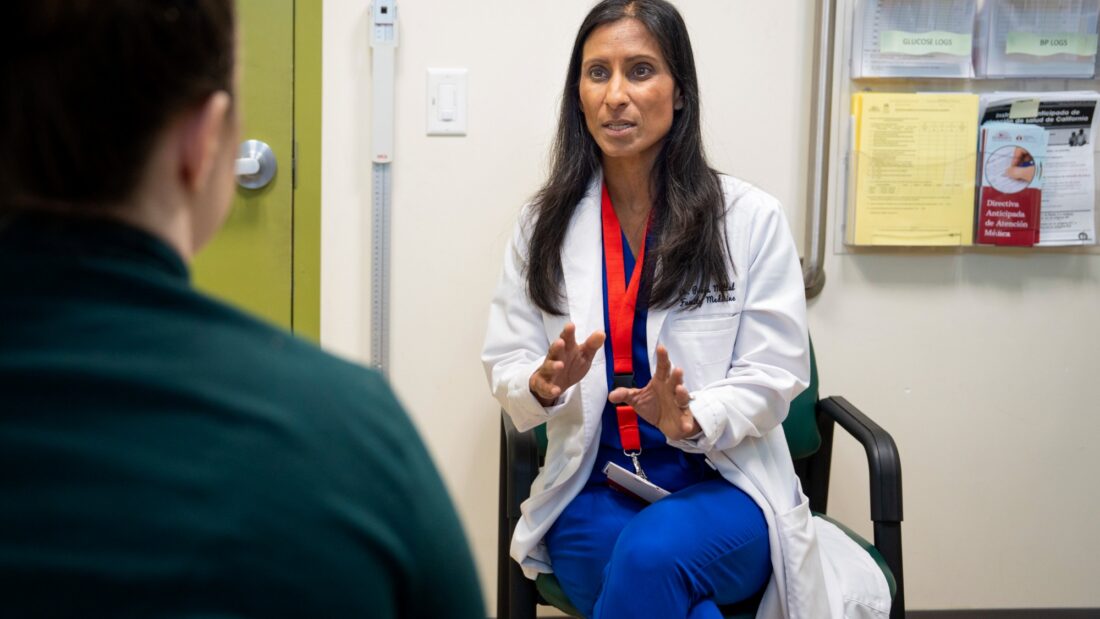
One of the first issues Pooja Mittal, DO, set out to solve when she took the job of chief health equity officer at Health Net was figuring out why in-network pediatric clinics in Downtown Los Angeles and South L.A. fell behind on getting Black families in for well-child visits.
“We began working with community members to identify barriers for those families, and we found low-hanging fruit,” she said.
The obstacles they uncovered were mostly logistical, she said. They were things like parents unable to leave work during regular clinic hours, challenges with transportation and parking, and clinics unwilling to let families schedule multiple children on the same day “because a no-show means losing two or three kids on the calendar,” Mittal said.
The solution was relatively straightforward: Extend clinic hours into evenings and weekends at two locations, adjust scheduling policies, and help parents with parking and transportation.
Ultimately, Mittal said, those operational adjustments helped the Black families served by clinics in Health Net’s provider network and other parents juggling similar work and family obligations.
“When you improve things for the most disparate population,” Mittal said, “you’re also improving things for everybody else.”
Raising the Bar to Address Disparities
Mittal’s role at Health Net is part of a relatively new state mandate. Beginning in 2024, the Department of Health Care Services (DHCS) required all managed care plans serving Medi-Cal, the state’s Medicaid program, to obtain health outcomes accreditation, identify and reduce disparities, and appoint a chief health equity officer to oversee the effort.
The goal is to make each health plan responsible for identifying and reducing disparities in care “to make sure people are getting the quality care they need to live healthy lives,” said Pamela Riley, MD, the DHCS chief health equity officer and assistant deputy director for quality and population health management.
Having a health equity officer in place at every plan was a major milestone for increasing accountability and leadership at the plan level, Riley said. Plans recognize that DHCS is holding them accountable for certain quality measures, she said.
“We say you have to improve care for these measures and for this subset, and if you don’t improve care, it’s actually going to cost you,” Riley said. “There absolutely are successes where the equity officer role is supported and leadership of the plan recognizes the importance of the role to their core operations of serving a particular Medi-Cal population.”
To improve outcomes, California has moved equity from the sidelines of quality care to its center.
Fifteen million Californians with low incomes or disabilities are enrolled in Medi-Cal. Since the 1990s, beneficiaries have largely received coverage through managed care plans as part of California’s effort to control costs and improve coordination of care.
A 2019 California Health Care Foundation report on more than two decades of managed care performance statewide showed “a very mixed track record,” said Christopher Perrone, director of the foundation’s Improving Access team. “Despite the promise of greater accountability, there was no improvement for members in over half the measures DHCS tracks.” In some cases, the study found, care worsened, “which runs counter to the purpose of managed care,” he said.
In an effort to improve outcomes, California has moved equity from the sidelines of quality care to its center. It’s a principle embedded in the Institute of Medicine’s landmark 2001 report, Crossing the Quality Chasm, which defined equitable care as one of the six fundamental aims of high-quality health care.
Quality Means Good Care for Everyone
If some groups consistently receive worse care than others, the report stated, a health system can’t be considered high quality. Riley said the principle remains central to the state’s Medi-Cal transformation strategy.
“You can’t improve the health of the population if you’re leaving part of that population behind,” she said. “You cannot do quality without equity … We’re still focused on meeting the needs of populations in California at the local level, where equity considerations are inextricably tied to that.
“It might be harder now,” she said. “There’s a lot of pushback. People ask, ‘Do we still have to do this?’ From the department level, yes, this is still a priority. We are moving forward with all of these things.”
The work of each equity officer varies widely depending on the health plan. So, too, do the professional backgrounds of those who fill the roles within the state’s 22 managed care plans.
Some officers, like Mittal, are physicians. Others have community organizing or public health backgrounds. Some report directly to the plan CEO, while others work within quality departments.
One common theme, however, is that most operate largely through influence rather than authority.
“My position doesn’t come with power like the CEO,” said Michaell Silva Rose, DrPH, LCSW, chief health equity officer at CalOptima Health in Orange County. She came to this work after 25 years leading a community benefits program at a local hospital. “Here we’re required to lead by influence.”
Health Equity Reframes Quality Care
Rose considers health equity a step beyond quality assessments.
“It’s quality-plus,” she said.
In practice, that means reviewing the same quality data as her colleagues but with a different lens.
“We’re like the detectives who go in and try to address gaps where we can do better and make it better for members,” she said.
Sometimes those gaps reveal unexpected connections, Rose said. Diabetes is one example of a condition that shows up on every needs assessment, with interventions typically focused only on diet and exercise.
“I rarely see interventions and education about diabetes and depression, or diabetes and anxiety,” she said. “So we’ve only been addressing diet and exercise and then wonder 25 years later why the rates aren’t going down.”
“When you overlay mental health variables like depression and anxiety,” she said, “the outcomes and disparities look different, and so do your interventions.”
Alex Li, MD, who formerly served as chief health equity officer at L.A. Care, agrees. Much of the work health equity officers do involves identifying where standard approaches fail to reach populations that would benefit most, then finding ways to fix those shortcomings.
While at L.A. Care, Li helped develop a virtual medicine program that allows medical specialists to remotely consult with street medicine providers so that patients experiencing homelessness can receive specialty evaluations outside traditional clinic settings.
Investing in such equity-driven solutions not only improves health outcomes for patients, he said, it saves money for health plans and makes the whole system work better.
“The inequities are a driver of higher health care costs,” Li said. “When hospitals get more uninsured people clogging up the emergency rooms, everyone has to compete for that same resource.”
How Community Input Shapes Equity
In the Central Valley, Sia Xiong-Lopez — a certified doula by training — became health equity officer for CalViva Health after a career in community advocacy.
The idea for her first initiative, she said, came from a community suggestion that surfaced in CalViva’s health equity survey. A member advocated for a focus on women’s health outside perinatal care. Women were asking for information on topics related to perimenopause and menopause, along with other women’s health issues many encounter later in life.
Last year, Xiong-Lopez organized several focus groups that gave 172 women information about this life transition, the expected symptoms, and how to talk to doctors about it.
When you improve things for the most disparate population, you’re also improving things for everybody else.
Pooja Mittal, DO — Health Net
The program also identified broader health needs among participants, she said, resulting in 140 referrals related to housing, mental health, and other social drivers of health. The initiative, Xiong-Lopez said, has since been incorporated into the Kings County community health improvement plan.
Health equity projects are continuing in various forms across California despite budget pressures, federal policy uncertainty, and growing political scrutiny of diversity and equity initiatives.
DHCS is considering providing more explicit guidance on expectations surrounding the chief health equity officer role. Riley said the state will continue to mandate despite federal pressure against equity programs.
“The department has not once taken our foot off the pedal,” she said. “We are still accountable for providing quality care to these populations, and you cannot do quality care without equity.”
Results, Not Rhetoric
To some, this moment marks a shift in how health equity work is being judged.
“I think we have exited the honeymoon phase of health equity,” said Katherine Haynes, MBA, senior program officer for improving access at the California Health Care Foundation. “There was a lot of goodwill — sometimes on programs without rigorous measurement of results where people were throwing money at programs that weren’t accountable for showing results. That time is over.”
Haynes said the focus now is less about rhetoric and more about demonstrating returns to both patients and health care organizations.
“This is really about misdiagnosis, mistreatment, and undertreatment for certain people because of their race, their gender, their English language proficiency, and other factors,” she said. “It’s about the fundamentals of health care quality — getting it right and getting the best care to everybody. And we can do better.”
Mittal agrees. “We can try to stop saying ‘equity’ and stop talking about inclusion and not say those words anymore,” she said. “But if you’re in health care, equity is at the center of what we do.”