|
Getting your Trinity Audio player ready…
|
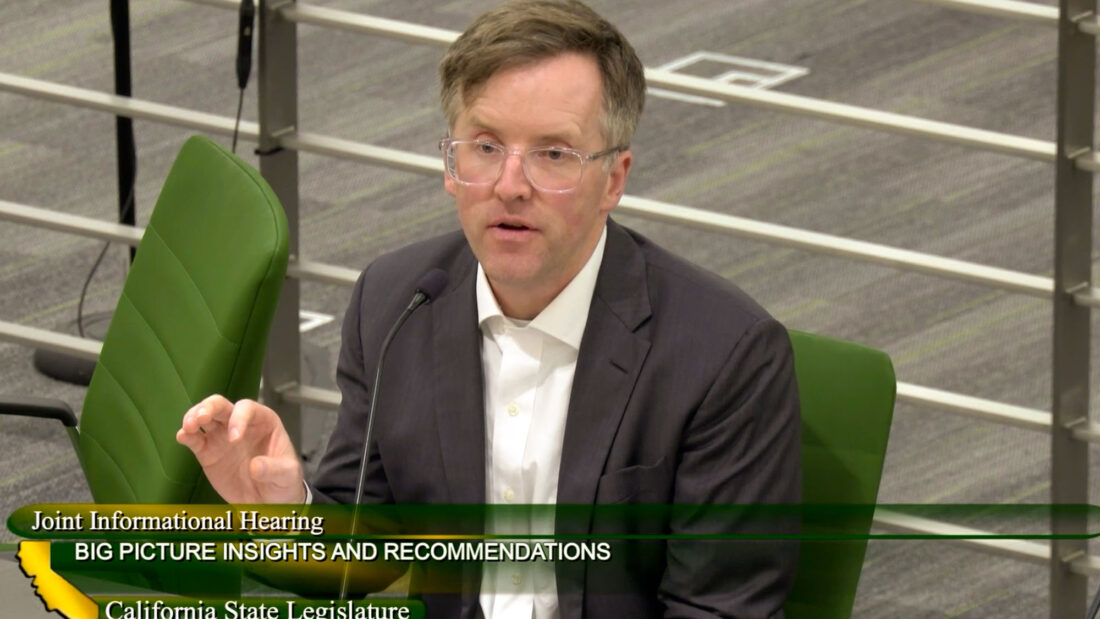
On March 10, 2026, Kristof Stremikis of the California Health Care Foundation (CHCF) testified at a joint hearing convened by the state Senate and Assembly health committees. Here is his testimony, edited for brevity and clarity:
My name is Kristof Stremikis. I’m the director of market analysis and insight at CHCF, an independent nonprofit philanthropy dedicated to ensuring that all Californians can get access to the care they need at a price they can afford.
You’ve already heard some very compelling stories about the health care affordability challenges that are so prevalent in this state. Here is some additional data.
In your background materials are the results of CHCF’s recent survey that we conducted among all Californians. There is so much data in there about the depth, scope, and scale of this problem.
Four Metrics to Explain the Affordability Crisis
- In the last year, 4 in 10 Californians reported that they or a family member were struggling with medical debt.
- 5 in 10 Californians say that their health care expenses are growing faster than their income.
- 6 in 10 Californians reported that in the last year they or a family member skipped care due to costs.
- Nearly 7 in 10 Californians reported that they are worried about medical bills. That’s higher than worries about gas, housing, rent, and electricity — all of the basic living expenses that Californians face in this very high-cost state. Health care is the No. 1 thing that they’re worried about.
For each of these stories that you’re going to share and hear later, there are literally hundreds of thousands and sometimes millions of Californians who are experiencing something similar.
The Root Causes of High Health Costs
It’s really important to focus on the drivers of this crisis.
What are the root causes of these consumer affordability challenges that we want to solve? The answer is incredibly complicated, but two main points stand out:
We cannot address the consumer affordability crisis without getting at the underlying cost of health care. Health care is too expensive for families because the underlying costs have been allowed to grow unchecked for decades.
These costs are things like hospital operating costs, prescription drug prices, and doctor’s fees. When those things go up year after year, they get passed on to patients through higher insurance premiums, forgone wage increases, bigger deductibles, and larger out-of-pocket expenses.
Twenty-five percent of underlying costs don’t help patients get better or improve the care. At CHCF, we call that “the 25% problem.”
Where is that 25% going?
- Administrative complexity and waste. This is slightly different from the administrative burdens that have been put in place now for enrollment in Medi-Cal. Drs. Weber, Pearson and Patel, I’m sure you live this in your practices. The nonclinical, administrative burden of delivering services explains about one-third of the expenses that we really need to pull out of our system if we’re going to make health care more affordable.
- Inflated prices: We also heard from Elizabeth Landsberg, director of the state Office of Health Care Affordability, about inflated prices that can be charged because there isn’t any competition, both horizontally and vertically.
- Lack of prevention: It is absolutely true that primary care is a necessity that pays off in the long run. We know that when people don’t have access to primary care, illnesses and complications develop that make people sicker and ultimately cost more.
Consumers Need Immediate Relief While California Implements Long-Term Solutions
The growth targets that have been put in place recently through the Office of Health Care Affordability are crucial as an overall goal. We need to do those things in the system. At the same time, we need to provide additional support to consumers.
Right now, there are millions of consumers in California who are struggling with high health care expenses. They have medical debt. There are things that can be done. Los Angeles County recently spent about $5 million to relieve hundreds of millions of dollars in medical debt owed by Angelenos. We need to provide that kind of immediate assistance to people who are struggling.