|
Getting your Trinity Audio player ready…
|

Editor’s note: The author sits on the advisory committee of the California Office of Health Care Affordability.
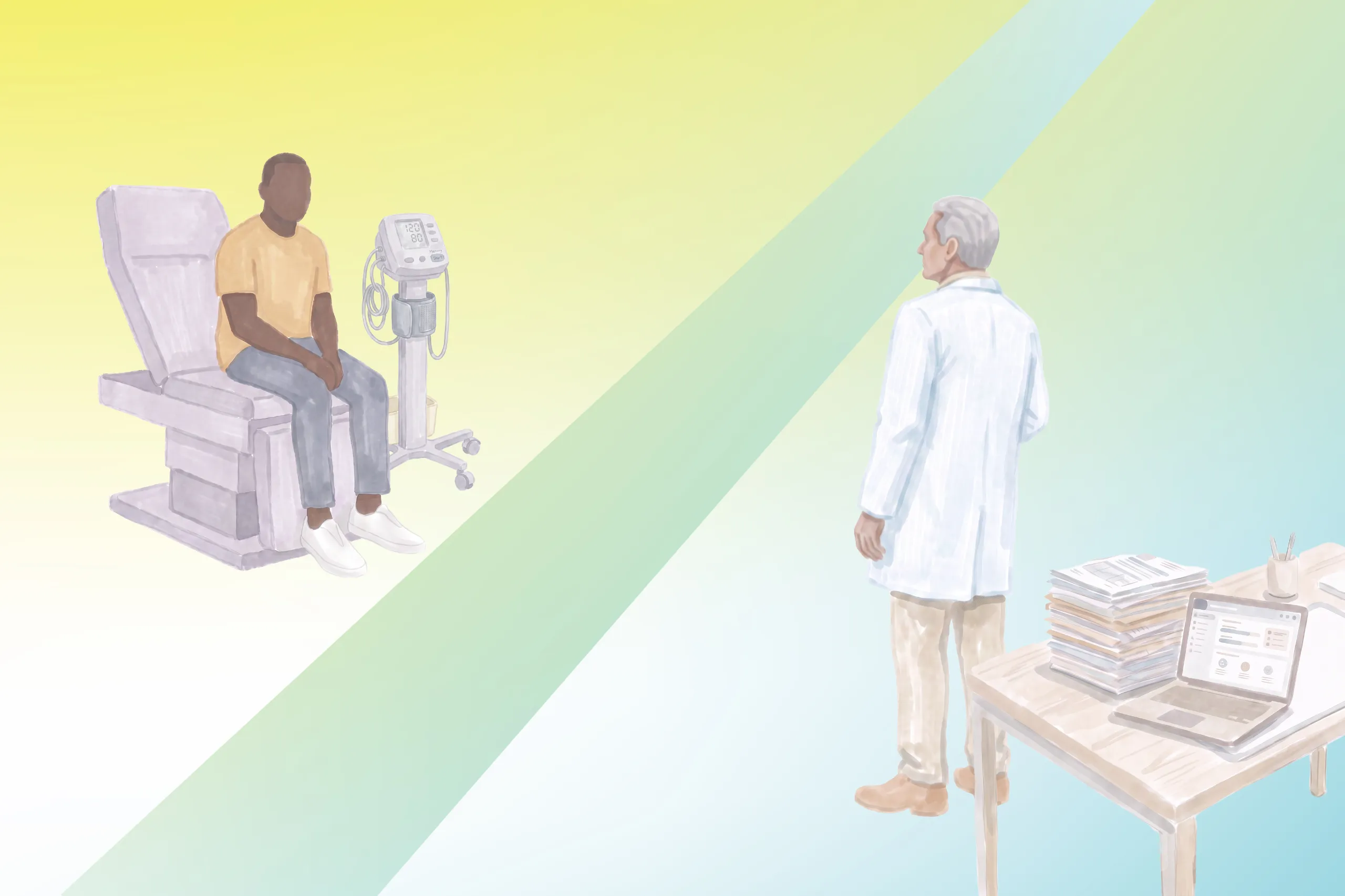
Consider this common scenario: A patient with chest pain sees a cardiologist. The heart specialist prescribes a new medication without contacting the patient’s primary care doctor to check whether the drug is compatible with the four other pills the patient already takes. Three weeks later, the patient is in the emergency department with an adverse reaction.
Every step in that process generates revenue except for the outreach to other clinicians who could have prevented the emergency. The health care system pays better for the failure than the prevention.

Trust Is Vital
For our 30th anniversary, we’ve invited health care leaders and experts to share solutions for building trust at all levels of the system. The views expressed in this series are those of the authors and do not necessarily reflect policies or opinions of the California Health Care Foundation.
With fee-for-service payment, the longstanding model that most health plans and providers still use, clinicians get paid for each test, visit, and procedure they deliver, and for nothing in between.
I led MemorialCare, an integrated health care delivery system serving southern Los Angeles County and Orange County, for 25 years. In that time, the health care industry produced remarkable clinical innovation. It also produced relentless cost increases that far outpace overall inflation.
Californians are caught in the middle, squeezed by prescription drug prices set with little competition and surging commercial health plan premiums. The resulting affordability crisis puts needed care out of reach for many Californians. A sustainable path to affordability requires public programs, commercial health plans, and providers to adopt alternative payment models (APMs) that pay providers for keeping patients healthy rather than for the volume of services they deliver.
No single program or industry sector can fix this problem by itself. It requires hospitals, health insurers, public payers, providers, and drugmakers to work together to change how care is paid for.
Paying for Health Instead of Volume
The framework for defining APM arrangements comes from the Health Care Payment Learning and Action Network, a public-private group convened by the Centers for Medicare & Medicaid Services. It is the common yardstick payers and providers use to describe how far they’ve moved away from fee-for-service.
Alternative payment models reduce or eliminate wasteful testing and the administrative cost of billings, denials, and appeals. California’s Office of Health Care Affordability (OHCA) uses the network framework to set state targets in a four-tier system. Tier 1 and Tier 2 keep fee-for-service billing largely intact. Tier 3 keeps per-service billing but adds quality and budget targets. Tier 4 replaces volume-based billing with population-based payment, often a fixed amount per member each month.
Patients cared for by Tier 3 and Tier 4 organizations receive higher-quality services, more consistent preventive care, and better chronic disease care. MemorialCare’s Medicare Advantage plans operate under a Tier 4 arrangement. That means we receive a set amount per member each month, and when care costs more than that budget, we absorb the difference. It means our financial interest and our patients’ health point in the same direction.
When providers share financial risk, total spending runs nearly 5% below spending under fee-for-service, and pharmacy costs drop by as much as 25%. Since 2016, almost all of MemorialCare’s commercial HMO and PPO alternative payment models have been in Tier 3 or Tier 4, the categories preferred by OHCA. Our experiences have led us toward three operational priorities:
- Shift care to lower-cost settings. Clinical innovations allow some hospital care to be delivered safely in outpatient settings at substantially lower cost and with faster recovery for patients.
- Integrate care. Patients with depression or anxiety show more improvement and lower cost when primary care doctors connect them directly to clinical social workers, reducing downstream emergency visits.
- Expand virtual services. These include urgent care, remote monitoring, and physical therapy.
What Clinicians Can Do Together
More than 8 in 10 Californians trust their personal physician. It’s the system around them that’s failing. It does not pay trusted clinicians to coordinate care with one another.
Fee-for-service pays providers for what they do alone and nothing for what they do together. That is the real cost of the model, and it explains why its sharpest critics include federal policymakers, health economists, employers, and purchasers.
Community clinics, integrated health systems, and advanced primary care practices, particularly those with strong data infrastructure, have been among the most willing to move away from fee-for-service. A fixed budget per patient gives clinicians a predictable pot of money and freedom to decide that a pharmacist’s call, a social worker’s referral, or a timely text message is the right intervention.
Under fee-for-service, organizations operate separately and must generate billable visits to stay solvent. The incentives reward volume, including care that may be unnecessary, and the documentation of every unit of it.
APMs organize payment around the patient. Through comprehensive, continuous, and coordinated care, primary care providers reduce unnecessary referrals to specialists. In 2021, MemorialCare adopted eConsult, a system that lets a primary care doctor send a clinical question directly to a specialist and get an answer without the patient making a separate appointment. Since then, our physicians have conducted more than 21,000 provider-to-provider consultations. In 74% of them, the specialist gave the primary care doctor a treatment plan, and the patient avoided spending time on a specialty waitlist.
Under this arrangement, the cardiologist’s outreach to the primary care doctor is the paid work, not the unpaid favor.
APMs are saving money for enrollees too. Over the last decade, for example, MemorialCare has contracted directly with a large Southern California employer to deliver and administer care to its workforce under a Tier 3 arrangement. In the first year, we cut per-member pharmacy spending by more than 20% despite rising market costs. Our pharmacists identified cases in which employees were using high-cost prescription drugs when therapeutically equivalent over-the-counter drugs were available for far less and worked with prescribers to switch them. Every year since, cost trends for employees in the plan have run below those for employees who aren’t enrolled. Enrollees also see lower payroll contributions and deductibles.
What Needs to Happen Next
The health system is moving in the right direction, but it is moving too slowly. Less than one-third of US health care payments flow through Tier 3 or Tier 4 contracts. Federal policymakers should make it easier for providers to take on financial risk.
The federal Center for Medicare and Medicaid Innovation has invested in pilot programs that prioritize outcomes over volume. It launched a model that gives groups of doctors and hospitals a set budget to manage all of a patient’s care. To bring more providers in, the innovation center should let them keep a share of the money they save for the first few years of participation before requiring them to cover overruns. The organizations most hesitant to move often hold the thinnest financial reserves. They are frequently the same organizations caring for patients who face the greatest barriers to care.
California regulators should enforce what they have already called for. The affordability office requires health plans to steadily increase enrollment in APMs. The office enforces growth targets that limit how fast total health care spending can grow within health plans, hospitals, health systems, and large medical groups. It should publish payer performance data and penalize plans that fall short of enrollment targets. The state treats one obligation as binding and the other as aspirational.
Speed matters, and delivery systems should build the capacities they will soon need to comply with the state’s health care spending policies. As trust and cooperation increase among clinicians, patients will notice more streamlined, personalized care.
Somewhere in California today, a cardiologist is writing a prescription. No one is checking it against the patient’s other medications to avert complications. That could become far less commonplace with wider use of alternative payment models.