PACE (the Program of All-Inclusive Care for the Elderly) is a unique care model that provides comprehensive medical and social services to older adults with complex needs. First piloted in San Francisco in the 1970s as a way for aging immigrants to receive support to remain in their homes, PACE became a permanent Medicare program and an optional Medicaid benefit for states in 1997. Today, the model reaches more than 96,000 people across 33 states and the District of Columbia.[1]
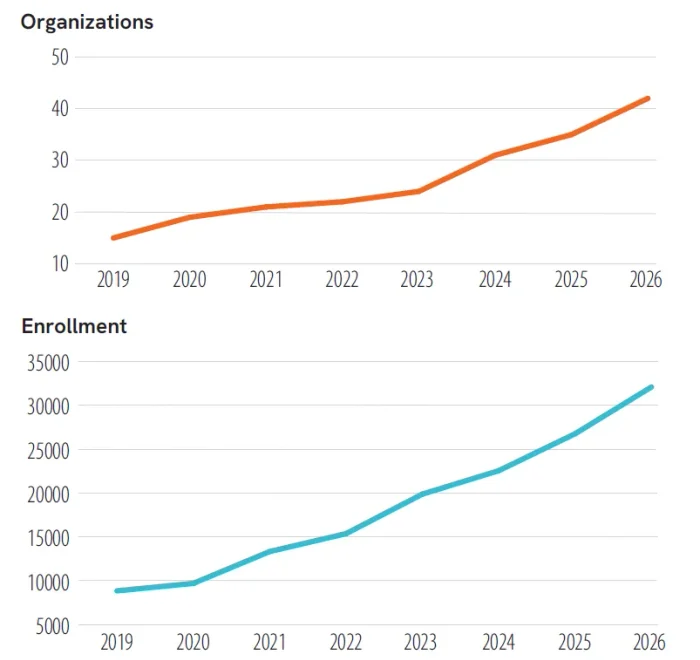
For years, California’s PACE program was relatively small, growing incrementally over time. More recently, it has expanded significantly (Figure 1). This acceleration reflects California’s growing older adult population, increased interest in the PACE model, and policy changes. In 2016, California removed caps on the number of PACE organizations in the state and newly allowed for-profit entities to participate in PACE.
Figure 1. Growth of PACE Organizations and Overall PACE Enrollment, California, 2019–26
Sources: A Look at PACE Growth by the Numbers: States, Organizations, and Enrollment, ATI Advisory, October 2025; A Look at PACE Growth by the Numbers: States, Organizations, and Enrollment (PDF), ATI Advisory, July 2024; PACE in the States (PDF), National PACE Association, July 2026; and California PACE Plans (PDF), California Department of Health Care Services, July 2026.
Notes: ATI reports pull data from the National PACE Association’s “PACE in the States” monthly snapshots. Data for this figure came from the following snapshots: September 2019, April 2020, December 2021, July 2022, December 2023, June 2024, July 2025, and July 2026. PACE organization data reflect individual contracts with the US Centers for Medicare & Medicaid Services. For years without published data, organization numbers were derived to the best possible accuracy using program start dates and regional counts.
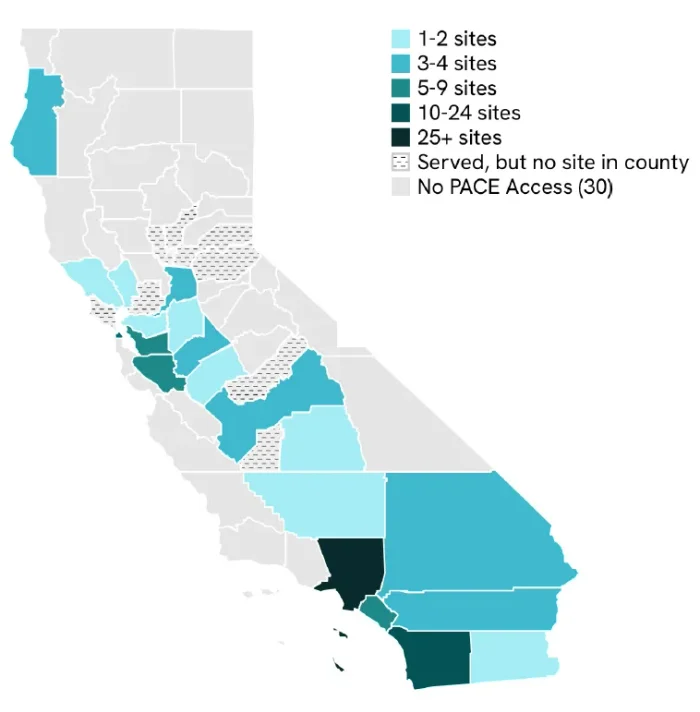
Despite this growth, gaps in access persist, with PACE serving about half of California counties.[2] In late 2025, California’s Department of Health Care Services instituted a temporary (minimum two-year) pause on accepting applications for new PACE organizations and expansion of existing organizations to manage the rate of growth and ensure adequate resources to manage the program.[3]
Who is eligible for PACE, and how is it different from other models serving older adults?
To enroll in PACE, a person must be age 55 or older, require a nursing facility level of care, be able to live safely in the community with the right supports, and live in a PACE service area. Most PACE participants (82% nationally, 70%–78% in California) are dually eligible enrollees, meaning they qualify for both Medicaid and Medicare.[4] While California has other health care delivery models, such as Medi-Medi Plans, that aim to coordinate Medicare and Medicaid services for this population, PACE is unique in that it functions as both a payer and comprehensive care provider that serves a narrower and more complex population.
What services does PACE offer?
- Medical care (e.g., doctor visits, hospital stays)
- Dental care
- Behavioral health care
- Pharmacy care
- Transportation services
- Long-term services and supports (e.g., home health aides, medical equipment, assisted living or nursing facility stays)
- Social services (e.g., medically tailored meals, nutritional counseling, recreational programs)
- Any other service not traditionally covered by Medicare or Medicaid that the PACE interdisciplinary team determines is necessary to enable the participant to remain in their home or community
PACE Unifies Services to Meet Complex Health Needs
- Wraparound services. PACE delivers and coordinates an extensive range of medical and social services — from primary and specialty care to behavioral health and nutrition classes — through one organization.
- One core provider. PACE organizations function as integrated providers that oversee all authorized services, including those usually carved out to systems run by counties or fee-for-service Medi-Cal, California’s Medicaid program. Most services are delivered at brick-and-mortar PACE centers. When necessary, PACE organizations contract with other providers like hospitals, assisted living facilities, and specialty practices to deliver additional services to their members.
- Better outcomes. Compared to similar populations not enrolled in PACE, research has found that program participants have better health outcomes, including reduced hospitalization and mortality rates.[5]
- Patient satisfaction. In 2025, 92% of independently surveyed California PACE enrollees said they would recommend their PACE organization to a close friend or relative in need of this kind of care.[6] Nationally, PACE also has lower rates of disenrollment than other programs that target a similar population, like Medicare Advantage plans.[7]
PACE’s Structure Incentivizes Preventive, Community-Based Care
- Braided, capitated funding mechanisms. PACE is financed through a joint state-federal structure with capitated Medicare and Medicaid funding streams, enabling providers to pool payments across both programs. This creates incentives for PACE organizations to focus heavily on preventive care and services that address their enrollees’ health needs in home and community settings, despite those enrollees being eligible for nursing facility care.
- Lower care costs compared to other settings. Federal rules require California to pay PACE providers less per enrollee than the state would spend on similar services in other settings, including nursing homes. Compared to older adults enrolled in other plans, PACE participants also have lower rates of hospital admission and emergency room utilization, both of which are costly.[8]
California’s PACE Program Has Grown, But Gaps Remain
- Rising enrollment rates. As of July 2026, California is home to 42 PACE organizations that operate 124 PACE centers and alternative care sites, and more than 32,000 Californians are enrolled in PACE across 28 counties.[9] Californians account for about one-third of PACE enrollment nationwide.[10] The number of PACE organizations in California has more than tripled in the last decade, while individual enrollment has tripled since 2020.
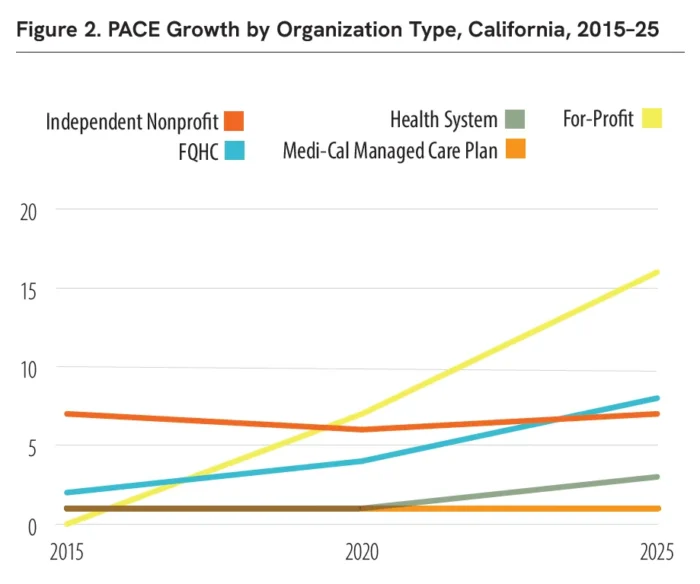
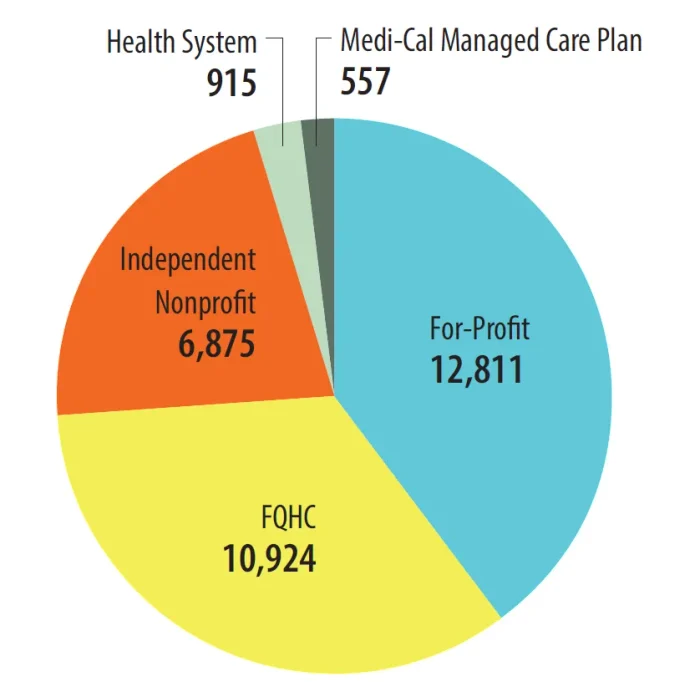
- Evolving organization types. Between 2015 and 2025, organization types diversified, with Federally Qualified Health Centers and for-profit organizations seeing more growth than other organization types (Figure 2). In 2026, 40% of California PACE enrollees are in for-profit programs, which include individual- or family-owned and operated programs as well as entities backed by private equity or venture capital (Figure 3).
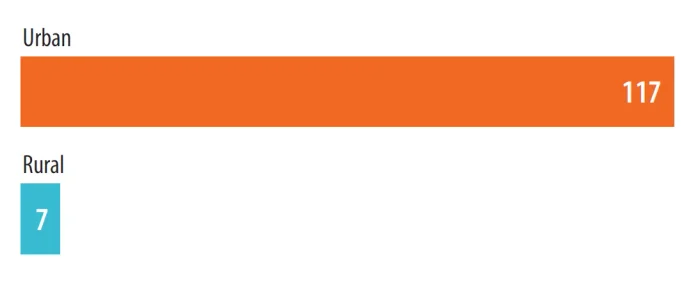
- Rural service gaps. While access points have multiplied, service gaps persist — especially in rural parts of the state where older adults live farther from potential service centers, and health workforce gaps are significant. Of the 124 designated PACE centers and alternative care sites currently in operation in California, 94% are located in designated urban areas (Figures 4 and 5).
Figure 2. PACE Growth by Organization Type, California, 2015–25
Sources: PACE in the States (PDF), National PACE Association, July 2026; and California PACE Plans (PDF), California Department of Health Care Services, July 2026.
Notes: FQHC is Federally Qualified Health Center. Organizations classified and back-dated by author based on available data and not by official authorities. Counts are for the years 2015, 2020, and 2025 only.
Figure 3. PACE Enrollment by Organization Type, California, 2026
Sources: PACE in the States (PDF), National PACE Association, July 2026; and California PACE Plans (PDF), California Department of Health Care Services, July 2026.
Notes: FQHC is Federally Qualified Health Center. Organizations classified by author based on available data and not by official authorities. Enrollment numbers were unavailable for the two newest PACE programs: Complete Care PACE (FQHC, Los Angeles) and Vista Community Clinics (FQHC, Los Angeles).
Figure 4. PACE Centers and Alternative Care Sites, Urban vs. Rural, California, 2026
Source: Addresses are from Karli Holkko (senior director of policy, CalPACE), personal communication with author, August 28, 2026.
Notes: Geographic designations follow the Medical Service Study Area conventions used by California’s Department of Health Care Access and Information and approved by the California Healthcare Workforce Policy Commission. These delineations follow US Census tracts.
Figure 5. PACE Centers and Alternative Care Sites by County, California, 2026
Sources: California PACE Plans (PDF), California Department of Health Care Services, July 2026; and Karli Holkko (senior director of policy, CalPACE), personal communication with author, August 28, 2026.
Note: Some PACE organizations serve zip codes located in adjacent counties that do not have their own stand-alone PACE centers or sites.
Learn More About PACE
- “Ambitious PACE Organizations Expand Services Under CalAIM.” Read about the history and early implementation of the PACE model in San Francisco, as well as how PACE organizations are expanding their impact under CalAIM (California Advancing and Innovating Medi-Cal).
- National PACE Association. Explore state-by-state data tools, administrative toolkits, policy briefs, and national enrollment census counts.
- CalPACE. Access critical information about California PACE providers, programs, and state policy updates.
- DHCS. California’s state health care agency publishes policy updates and answers questions about PACE.
- MACPAC PACE Report. This policy analysis breaks down PACE payment and funding models.
- ATI PACE Growth Report. See how the PACE market and footprint have grown in the past decade.
- NORC Market Assessment (PDF). Learn about how for-profit expansion into PACE has impacted the program.
Download the Explainer
PACE in California: A Growing Model for Complex Care
Endnotes
[1] PACE in the States (PDF), National PACE Association, July 2026.
[2] Janice Grandi, “California’s Solution for Senior Health Care Hides in Plain Sight,” CalMatters, December 19, 2025.
[3] Joseph Billingsley (acting division chief, Integrated Systems of Care Div., DHCS) to PACE organizations, “PACE Application Pause and Related Changes” (PDF), Policy Letter 25-02, November 17, 2025.
[4] Val Sheehan (CEO of CalPACE), personal communication with author, August 7, 2026; and author analysis of A Look at PACE Growth by the Numbers: States, Organizations, and Enrollment (PDF), ATI Advisory, October 2025, 12.
[5] “Understanding the Program of All-Inclusive Care for the Elderly,” chap. 4 in Report to Congress on Medicaid and CHIP, Medicaid and CHIP Payment and Access Commission (MACPAC), June 2025.
[6] Data from work performed by Vital Research, attained through Val Sheehan (CEO of CalPACE), personal communication with author, August 7, 2026.
[7] PACE by the Numbers (PDF), National PACE Association, October 2023.
[8] “Understanding the Program” MACPAC; and Zhanlian Feng et al., Integrated Care and Health Outcomes for Dual Eligible Individuals (PDF), US Department of Health and Human Services, March 2026.
[9] PACE Across California (PDF), CalPACE, 2026; and California PACE Plans (PDF), California Department of Health Care Services, July 2026.
[10] A Look at PACE Growth by the Numbers: States Organizations, and Enrollment, ATI Advisory, 14.