|
Getting your Trinity Audio player ready…
|
Katie Heidorn, CHCF’s state health policy director, testified on Aug. 5 to the California Assembly Budget Subcommittee No. 7 on Accountability and Oversight about the effects of federal and state policies on indigent health. Here are her full remarks:
Good morning, Mr. Chair and members,
I’m Katie Heidorn, Director of State Health Policy for the California Health Care Foundation.
As many of you know, the foundation is an independent, nonprofit philanthropy that works to improve the health care system for all Californians, especially those facing the greatest barriers to care.
I’m pleased to be with you today to talk about how to keep the new uninsured connected to health care.
I’d like to start with where we are. Federal and state policy changes are likely to result in large-scale coverage losses among Medi-Cal enrollees. Unfortunately, this is happening, and soon.
We should be clear-eyed about the scale here. Two million Californians are expected to become newly uninsured because of these policy changes. These are people who have coverage today, understand how to access health care, and will lose it. The problem is large — and we are still trying to understand its extent.
Make no mistake: We will be going backwards. California has spent the last decade making real progress — reducing its uninsured rate to the lowest level ever. That progress was built on a few clear pillars: statewide coverage, a focus on primary care, and no barriers to access. Those pillars are exactly what’s now at stake.
The question in front of us is simple. When people lose coverage, how does California respond? We believe the answer has to be a statewide one.
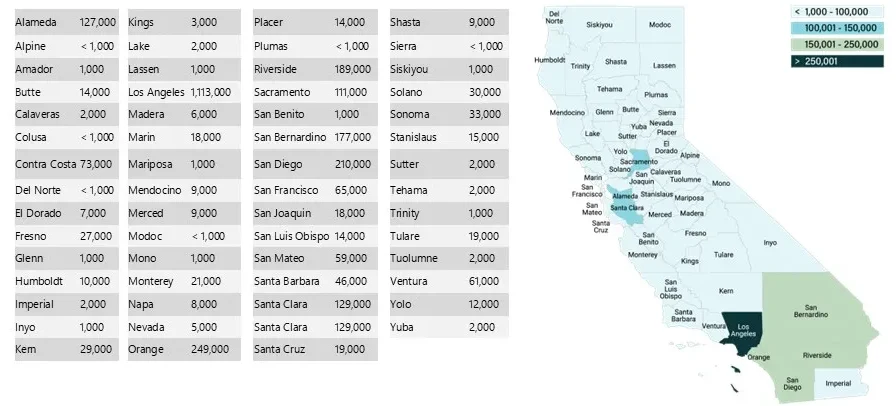
Where Are the New Uninsured?
Projected Medi-Cal Reduction by County, 2028
State Leadership, Not a County Patchwork
Prior to the implementation of the Affordable Care Act, Covered California, and our many Medi-Cal enrollment expansions, California had a patchwork of county-based health care programs for uninsured adults. For example, in Sacramento County, people had access to certain benefits and in Yolo County, they were different. You can learn more about those historical programs, as well as some experiments with more statewide programs, in a paper we published last September.
Now, as we face this new uninsured crisis, we can’t simply leave this problem to individual counties. As you heard on the previous panel, counties are working hard to figure out how they are going to manage health care for the new uninsured, but this is a statewide problem that requires a statewide solution. Many of you heard as much at a hearing in January when Dr. Sandra Hernandez, CHCF’s President and CEO, testified.
Leaving it to counties to solve this on their own means duplicated efforts and inefficiency, and it would leave huge gaps in care based on where people happen to live, just like in the past.
A county-by-county approach also creates “haves and have nots.” It would deepen the very gaps we’ve worked so hard to close.
A statewide approach does the opposite. It creates consistency, so a person’s access to care doesn’t depend on their ZIP code. And it matches the scale of the problem, providing a coordinated bridge to coverage for all Californians facing disruption.
Not Providing Care Costs Far More
Some will ask whether the state can afford this. The real question is whether we can afford the alternative.
Delayed care is expensive care. When people lose coverage, they don’t stop getting sick. They delay care until they end up in emergency rooms, driving up premiums and straining hospital infrastructure. Data from undocumented Californians already shows anticipated increases in ER visits when coverage is lost. This is a predictable, preventable crisis.
It also weakens the safety net. Uncompensated care hurts individuals, and it destabilizes the health care delivery system, threatening the hospitals and clinics that entire communities depend on.
So doing nothing isn’t the cheap option. It’s the expensive one.
What a Feasible State Approach Looks Like
Now, the good news. We don’t have to start from scratch.
Our guiding principle is to build on what already works and keep it simple. Prioritize simplicity by using California’s existing Medi-Cal infrastructure, including proven models like the County Medical Services Program (or CMSP), the Low-Income Health Program, and Healthy San Francisco, rather than creating new systems. That reduces time, cost, and administrative burden, and it gets help to people faster.
It also centers the key pillars that I mentioned earlier: Statewide coverage, a focus on primary care, and no barriers. These made past progress possible, and they should guide what comes next.
In addition to these principled pillars, we will need good data to guide us. Good data will tell us the size of the problem, what is working, and what isn’t. We should commit to collecting data deliberately. For example, we will need to:
- Track ER visits and uncompensated care before and after coverage loss, so we can see the true cost of inaction and the return on providing coverage.
- Monitor Medi-Cal enrollment and disenrollment by county and by population, so we can spot gaps and reconnect people to the Medi-Cal system.
- Measure primary care access and utilization, since keeping people connected to primary care is what keeps them out of the emergency room.
California has come too far to let this progress slip. A statewide approach protects what we’ve built, creates a practical pathway to care for all Californians, and positions us to build back to universal coverage when the opportunity presents itself in the future.